
Move Over Power—Spin Is In!
by Pickleball Central Paddle Experts on Aug 17, 2026
Equipment trend
Why paddle makers—and the players buying from them—are chasing shape, dip and durable bite as legal power approaches a regulated ceiling.
For several seasons, the easiest way to sell a premium pickleball paddle was to promise more: more pop, more exit speed, more put-away power. That arms race has not disappeared, but the rules have changed the direction of travel. Once a paddle is already near the legal power ceiling, a brand cannot simply make it hotter. It has to make it more useful.
That is why spin has become the new headline. The most interesting paddles of 2026 are not merely powerful. They pair near-ceiling rebound with surfaces designed to grab the ball, shape its flight and keep that bite longer. For players, the question is shifting from “How hard does it hit?” to “What can I make the ball do?”
Power now has a hard boundary
USA Pickleball introduced its Paddle/Ball Coefficient of Restitution (PBCoR) test to quantify rebound power. Its published standard moved from a 0.44 limit to 0.43 effective November 1, 2025. UPA-A uses a different metric—Paddle Efficiency Factor (PEF)—but reaches the same policy outcome: new paddles must test at 0.385 PEF or below, with a post-break-in allowance up to 0.405. In both systems, the message to manufacturers is clear: there is a defined upper boundary for energy return.
That does not prove every leading paddle has identical power, and “most top brands have reached the ceiling” is too absolute to state as a measured fact without model-by-model certification data. What the market does show is a crowded band of premium paddles engineered close to the permissible limit. PickleballCentral, for example, lists the Six Zero Coral Pro Elongated at 0.42 PBCoR against a stated 0.43 limit. Once products cluster there, another fraction of rebound is a smaller differentiator than a surface that changes trajectory.
Spin is regulated too—but it still offers room to innovate
Spin is not an unlimited loophole. UPA-A currently sets a maximum spin rate of 2,100 RPM (revolutions per minute) for certification and requires paddles to remain under that limit throughout their useful life. USA Pickleball has announced the same 2,100-RPM maximum for new certifications beginning October 1, 2026, replacing pass/fail upper thresholds for roughness and coefficient of friction with direct spin-rate testing.
The important distinction is how brands can compete below that ceiling. A high-spin paddle must generate useful rotation, do it consistently across the face and keep doing it after hundreds or thousands of impacts. That last point—spin durability—is becoming as important as day-one spin.
0.43USAP PBCoR ceiling now in effect
2,100 RPMUPA-A cap; USAP begins Oct. 1, 2026
The reviewers are measuring the shift
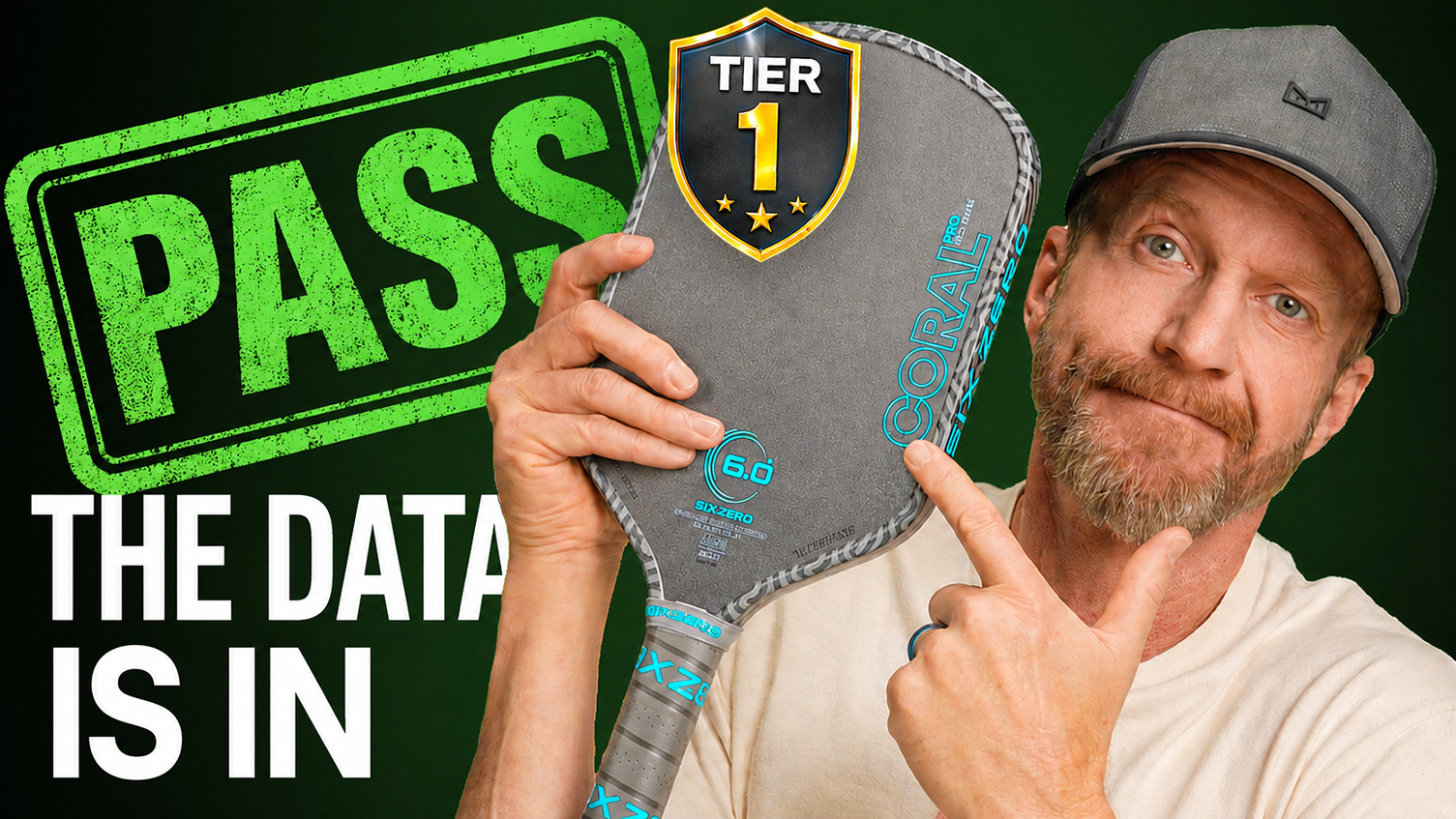
John Kew’s independent database labels more than 2,300 revolutions per minute “Elite” within his human-swing protocol and recommends filtering not only by initial spin but by durability. His current Tier 1 group—0% to 5% loss in accelerated wear testing—includes Honolulu Blue Grit, Six Zero Coral Pro, 11SIX24 HexGrit and the original Spartus PermaGrit surfaces. His Coral Pro review calls its spin elite and reports no measurable loss after 100 concentrated high-speed impacts.
Pickleball Effect reaches the same conclusion with a different protocol. Its June 2026 ranking puts the RPM Q2 Elongated 14 first at 2,176 revolutions per minute in that tester’s database, names the Six Zero Coral Pro the best spin-and-control option, and selects the 11SIX24 Power 2 Ultre for spin plus power. Crucially, the article warns readers not to compare raw spin across reviewers: equipment, swing speed and shot type differ. Rankings are meaningful within each tester’s system, not across systems.
Matt’s Pickleball supplies another independent signal. Its 2026 camera-measured leaderboard places all three Coral Pro shapes first through third, followed by Honolulu’s J2CR and J6CR Crystal Blue models. Pickleball Studio’s annual paddle-awards coverage likewise treats spin as a core performance category alongside power, control and value. The broader pattern matters more than any single number: reviewers now maintain dedicated spin rankings, test grit wear and make surface technology a central part of the buying conversation.

Why players want spin
- More margin on drives. Topspin lets an aggressive ball clear the net and dive back into the court.
- More pressure without reckless pace. Roll volleys, topspin dinks and shaped speed-ups can move opponents and attack feet.
- More variety. Slice returns, dipping third shots and angled counters create problems that straight-line speed cannot.
- More confidence over time. Durable grit reduces the familiar drop-off when a fresh raw-carbon face begins to smooth out.
The new spin-first paddle shortlist
| Paddle / family | Why it fits the trend | Approval* | Availability |
|---|---|---|---|
| Six Zero Coral Pro | Diamond-infused peel-ply surface; elite spin and Tier 1 durability in John Kew testing; three shapes. | UPA-A | PickleballCentral |
| Honolulu J2CR/J6CR Blue Grit | Elite spin plus Tier 1 retention in John Kew data; J2CR measured 2,424 revolutions per minute in his protocol. | UPA-A | Brand/direct |
| 11SIX24 Power 2 Ultre | Pickleball Effect’s spin-and-power pick; durable HexGrit family also earns Tier 1 status from John Kew. | UPA-A | Brand/direct |
| RPM Q2 series | Four of Pickleball Effect’s top five; Q2 Elongated 14 led that database at 2,176 revolutions per minute. | USAP | PickleballCentral |
| Selkirk LUXX Control Air InfiniGrit | Control-oriented 19mm platform; retailer says InfiniGrit triples spin durability versus the prior surface. | USAP | PickleballCentral |
| Spartus PermaGrit models | Original PermaGrit varieties earn John Kew Tier 1 spin durability; verify the exact model’s approval. | Varies | Brand/direct |
*Approval can be sanctioning-body- and model-specific. Confirm the current approved list before tournament use.
What to look for before buying
Do not shop by revolutions per minute alone. First, compare paddles tested by the same reviewer. Second, look for retention data—not just a fresh-face result. Third, match shape and mass to your stroke: a high-spin face will not help if the swing weight slows your hands or the sweet spot punishes misses. Finally, verify whether you need USAP, UPA-A or both. The Coral Pro is a perfect example of why: it is a compelling spin story, but its current listing is UPA-A approved rather than universally approved.
The next arms race is controlled rotation
Power still sells, and players will always enjoy a paddle that finishes the point. But the governing bodies have made raw rebound a regulated resource. As premium models gather near that boundary, the smarter differentiator is what happens around it: dwell time, surface friction, durability and the ability to turn a fast swing into a ball that bends, dips and jumps.
So, move over power. Spin is in—not because speed has stopped mattering, but because the best new paddles are learning to do more with the speed they are allowed to have.
Sources and further reading
- USA Pickleball: Equipment Standards Manual
- USA Pickleball: Spin Rate Test update
- UPA-A: Paddle Specifications and Testing Requirements v26.6
- John Kew: Paddle Database
- John Kew: Six Zero Coral Pro review
- Pickleball Effect: Best paddles for spin, 2026
- Matt’s Pickleball: Best spin paddles, 2026
- Pickleball Studio: 2025 Paddle Awards
- PickleballCentral: High-spin paddle collection
Share Product:
SHARE THIS: