
Proton Project Flamingo vs Project Peacock
by Braydon Unsicker, @PickleballEffect on Feb 26, 2026

Proton Project Flamingo vs Project Peacock
A hands-on comparison of Proton’s Gen 3 vs Gen 4 construction, specs, and on-court performance.
If you’ve watched any amount of professional pickleball on the PPA Tour, you’ve likely seen a Proton paddle in the hands of some of the best players in the world, most notably Andrei Daescu. Daescu has won multiple medals in both men’s and mixed doubles using Proton’s Project Flamingo. While he’s still competing with the Flamingo at the time of this writing, Proton has since released a new paddle, the Project Peacock. This review compares those two paddles to help you decide which one better fits what you’re looking for in your game.
For this review, I tested the 15mm elongated versions of both paddles. I’ll start by breaking down the technology differences, then cover the specs, on-court performance, and finish with my recommendation.

I’m Braydon Unsicker from Pickleball Effect. I review paddles across the market and try to explain what actually matters when you’re choosing one, based on data and time on court rather than marketing claims.
Under the Hood: Technology & Build
These two paddles represent different generations of paddle construction. The Flamingo is what’s commonly referred to as a Gen 3 paddle, while the Peacock falls into the newer Gen 4 category. Gen 3 paddles use a polymer core, essentially a plastic-based honeycomb structure, while Gen 4 paddles move to full foam cores.
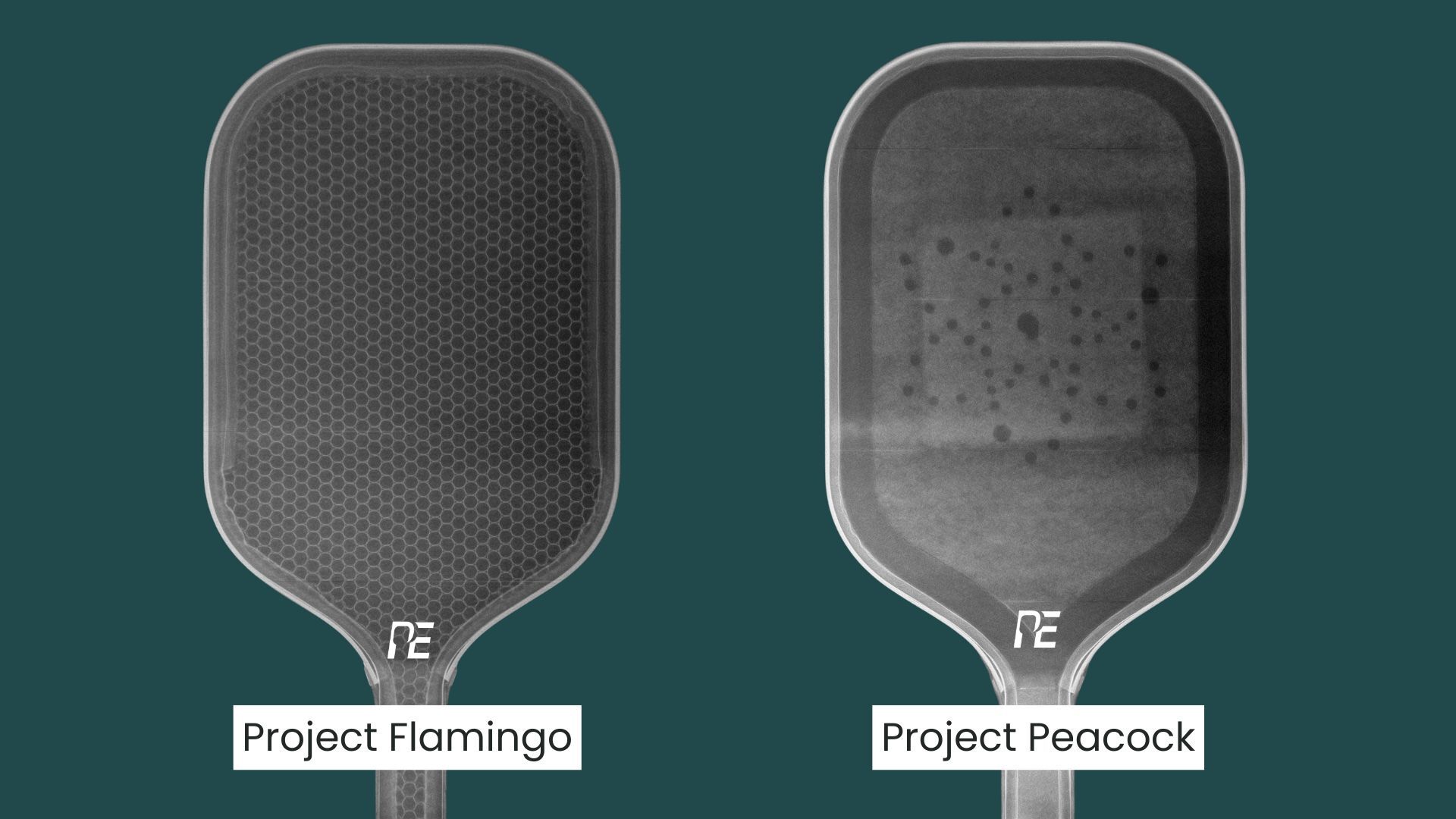
Above are X-ray scans showing the internal construction differences between the two paddles.
Project Flamingo
- Features a thin perimeter layer of added foam in a peninsula-style design. This adds some power, but the thinner foam wall keeps the paddle from becoming overly powerful.
- Uses a smaller, more tightly packed polymer honeycomb core, which contributes to consistency and better control.
- Gen 3 paddles like the Flamingo generally have a reputation for breaking down faster over time and don’t offer the same long-term durability as newer Gen 4 foam-core designs.
Project Peacock
- Uses a wider foam perimeter that fully surrounds the core in what’s commonly referred to as a floating core design. This adds more power and dwell time compared to the Flamingo’s thinner foam perimeter.
- Includes an Easter egg cutout of the Proton logo in the foam, paired with a square sheet of added fiberglass. The cutout helps soften the overall feel, while the fiberglass layer adds some pop.
- Gen 4 foam-core paddles, like the Peacock, generally have a stronger reputation for long-term durability compared to Gen 3 polymer-core paddles.
These design choices give the Flamingo an aggressive all-court playstyle, while the Peacock leans more offensive and fits into the mid-power category. The Peacock’s Gen 4 construction also brings a durability advantage, which is always a plus.
Paddle Specs
Measurements are from my review units and may vary between paddles.
| Metric | Flamingo | Peacock |
|---|---|---|
| Paddle Shape | Elongated | Elongated |
| Static Weight | 8.16 oz | 8 oz |
| Swing Weight | 121 | 117 |
| Twist Weight | 6.8 | 6.32 |
| Handle Length | 5.375 | 5.375 |
| Core | 15mm | 15mm |
Swing Weight
- The Flamingo has a higher swing weight and feels heavier in hand. That’s a plus on groundstrokes and when you have time to set your feet, but it can be a drawback in hand battles and will feel slower at the net.
- The Peacock comes several points lower in swing weight and feels more maneuverable overall. For me, it struck a good balance. Enough weight from the backcourt without feeling overly heavy at the net.
Twist Weight & Sweet Spot
- The Flamingo posts a strong twist weight, which translates to a larger, more forgiving sweet spot for an elongated shape.
- The Peacock’s twist weight is closer to average for an elongated paddle. That lines up with how it plays. The sweet spot is solid, just not oversized, which isn’t a negative as long as it’s not below average.
Handle Length
- Both paddles have shorter-than-average handles compared to the common 5.5” standard.
- Shorter handles can improve stability by shifting more mass into the paddle face, but you give up a bit of whip and space for two-handed shots.
- Players with larger hands or a two-handed backhand may wish for more handle length, while players with average to smaller hands or a one-handed backhand should be able to make it work.
On Court Performance
Power & Pop
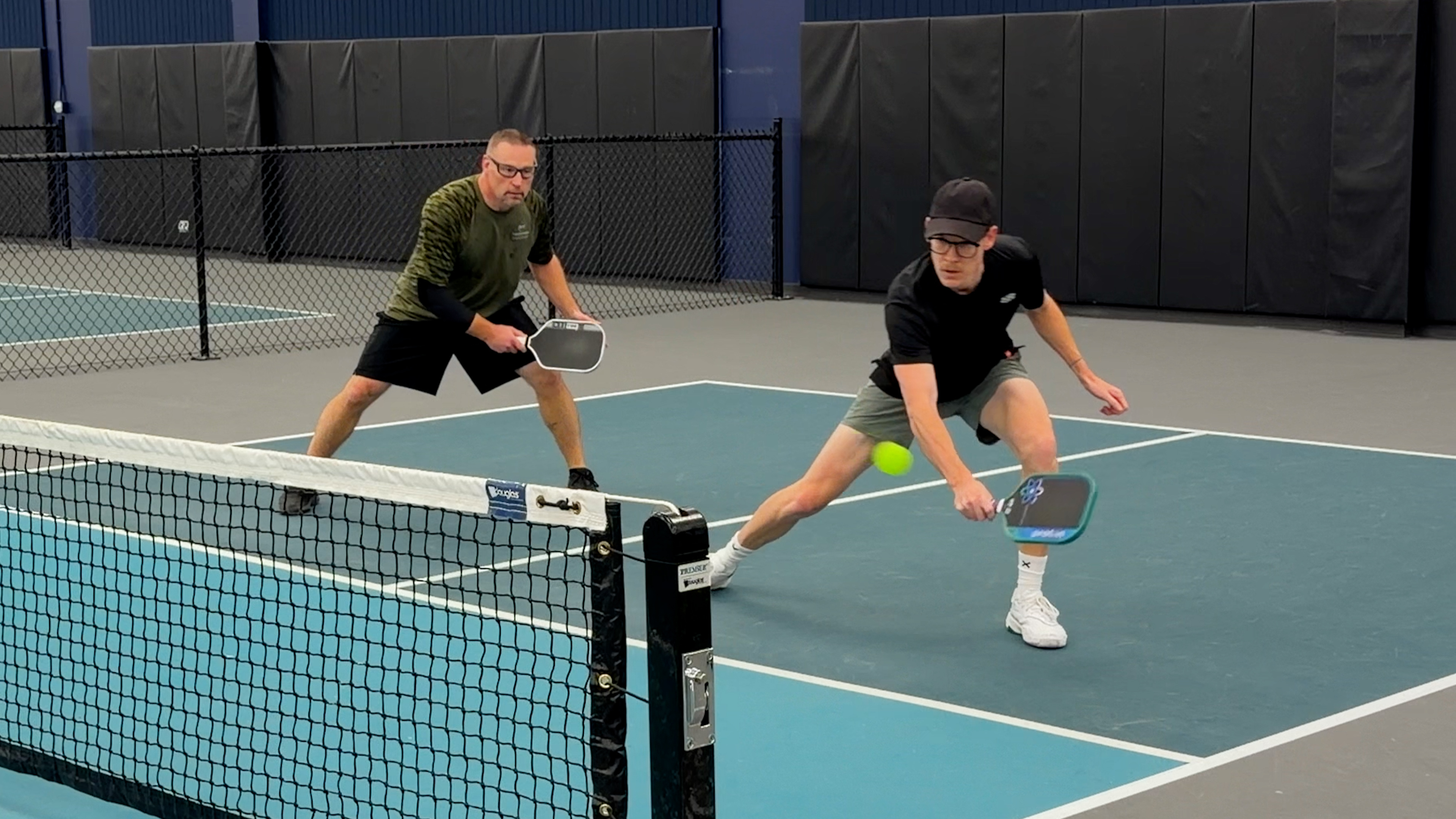
Along with on-court play, I run power and pop tests by hitting 10 serves and 10 punch volleys at full effort and measuring exit velocity with a Stalker Pro S3 speed gun. The Flamingo averaged 56.5 mph on serves and 36.3 mph on punch volleys, while the Peacock came in slightly higher at 56.9 mph and 36.5 mph. That tracks with how they play, with the Flamingo fitting an aggressive all-court profile and the Peacock offering more overall power and pop across the court and falls in the mid power category.
Control
The Flamingo is inherently a bit easier to control, as it absorbs more incoming pace than the Peacock. That said, the Peacock’s foam core allows the ball to pocket slightly more, which helps on the control side and makes it more manageable for a power-leaning paddle. Compared to power paddles from a year or two ago that lacked foam cores, the Peacock is noticeably more approachable. Power paddles have become more dynamic over time, but they still require more skill from the player to consistently manage that extra power.
In the Peacock’s X-ray, you can see a square fiberglass layer. I’ve seen this feature in other paddles, where that added fiberglass can create a springy, sometimes unpredictable response. With the Peacock, that didn’t really show up. There’s definitely pop available, but the bounce felt more consistent overall than I expected.
Impact Feel
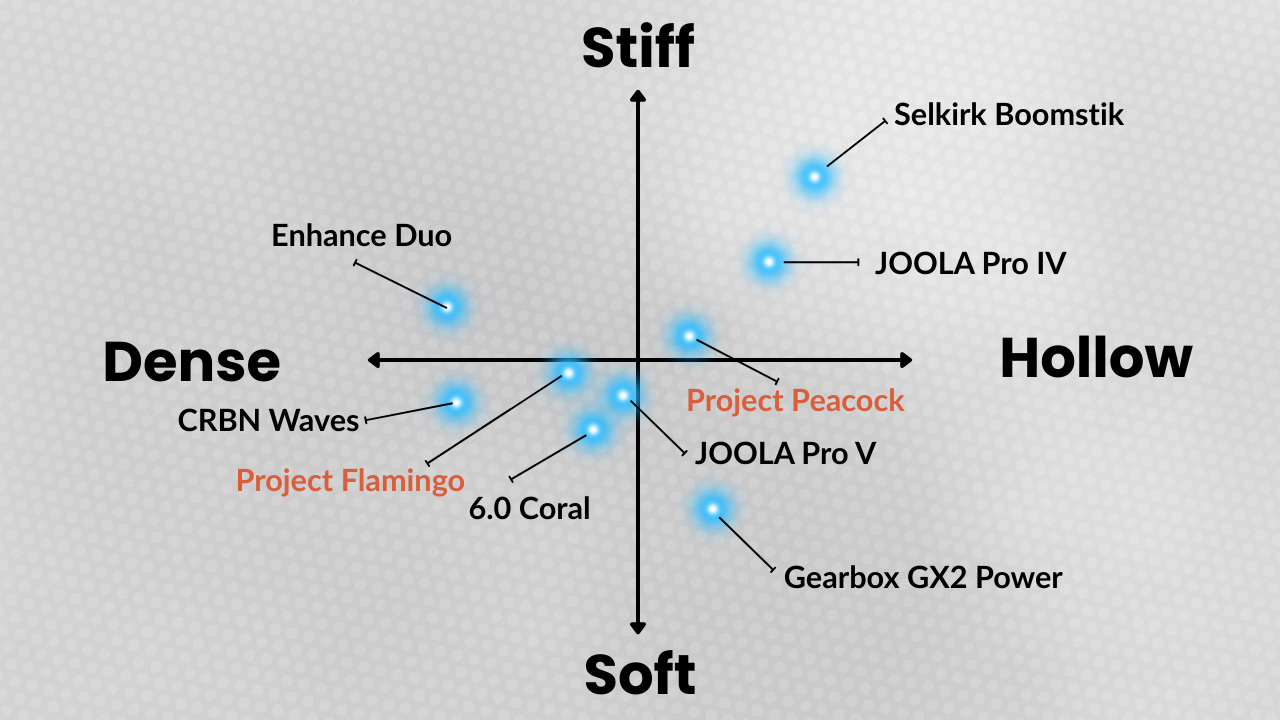
The Flamingo has a slightly dense and very full feel to it while the Peacock is a touch crisper and more lively sensation to it. Comparing the Flamingo to other Gen 3 style paddles like the JOOLA Pro IV it is a more dense feeling while comparing the Peacock to the other floating foam gen 4 style paddles it isn’t as stiff and hollow and gives you a smoother feeling in comparison. Here’s how I would map out how they feel in comparison to other popular paddles.
Sweet Spot & Maneuverability
The Flamingo felt noticeably heavier than the Peacock but offered a larger sweet spot. In some cases, that extra weight can help from the baseline by adding more mass behind your drives, but that advantage didn’t really show up here. The Peacock actually produced more power with less weight, which became especially noticeable at the net during hand battles.
While the Flamingo does have the more forgiving sweet spot, the Peacock was still solid for an elongated paddle. I liked the weight balance more of the Peacock. I felt the advantages of the lighter weight at the net was worth more to me than having some extra mass and forgiveness, especially since it was easy to tune the Peacock with tungsten tape .
Spin
Both paddles use peel ply texture, which is the most common form of surface grit, and both generate strong spin out of the box. Peel ply is known for producing excellent initial spin, though like most peel ply textured surfaces, it will wear down over time.
Recommendation
Both of these paddles play well, but after spending time with each of them, the Peacock is the one I’d recommend for most players.
The Peacock’s weight balance and overall performance are more attractive. It gives you extra offense and pop without feeling cumbersome, especially at the net, and it manages to do that without giving up too much control compared to the Flamingo, largely thanks to the extra dwell time from its foam-core construction. That same construction also adds a durability advantage, which is a meaningful upgrade if you want a paddle that holds up over time rather than feeling worn down after a few months.
The Flamingo still makes sense for players who want a more traditional aggressive all-court feel, value a larger sweet spot, and don’t mind the heavier swing weight. It’s predictable, stable, and has a very solid feel. But when you stack everything up—balance, offense, maneuverability, and durability—the Peacock feels like the more complete and forward-looking option.
If you’re choosing between the two and want a paddle that feels modern, offensive, and easier to play fast with, the Peacock gets the nod from me. And while Andrei Daescu continues to prefer the Flamingo, I think most everyday players are going to find more working in their favor with the Peacock.
About the Author
Braydon Unsicker is the founder of Pickleball Effect , where he has published independent paddle reviews since 2019. He has tested hundreds of paddles across major brands, using hands-on testing and performance data to help players find paddles that fit their game rather than chasing marketing claims.
Share Product:
SHARE THIS: