
LATE TO THE GAME? FIND THE SILVER LINING.
by Daniel Singer on Apr 8, 2026

A month ago, I asked my good friend Norm if he wanted to play in a tournament with me. The last time we played in one together—about a year and a half ago—we really struggled and didn’t even make it out of pool play. I was really frustrated at my game and let it get to my head which resulted in a downward spiral that I couldn’t recover from, which definitely affected our ability to play successfully together. A couple years before that, we played in one and took Bronze—where I won my first ever medal playing pickleball. Since then, I’ve never really had the desire to play in tournaments unless it was for a charity event or a fundraiser.
I don’t know why I had the itch to play in one again, but lately I’ve been having a great time playing with my rec guys, where we have all leveled up this last year. After receiving some consistent feedback about my deep, baseline-pinning drives, my crosscourt third-shot drop, or my fast hands in firefights, I guess I felt inspired to see how this would translate onto a tournament court. And Norm was the first—and only—person I’d want to play with.
I know Norm well and we have developed a playing relationship over the years. We communicate really well during and between points. We strategize on the fly and make necessary adjustments in real time. The best part for me—and why I trust him: He knows my disability and how to play WITH it effectively. He covers for me when necessary. He sees me, with a capital S. And because of the way he navigates his life, and the safety I feel with him, I am able to be my most authentic self as a pickleball player: one with an athlete’s mind but with a somewhat compromised body.
“What can I do to help Norm play his best today?”
Fast forward to tournament day. Our start time is 1:30pm. This tournament is being held at my club’s second location about 30 minutes from my house in Utah County. I arrive at 12:30 to stretch, hydrate, and warm up. I don’t see Norm yet but I’m assuming he’ll be here shortly. I see my other friend and his son who are playing in our same division and begin warming up with them. A half hour goes by and I still don’t see my partner. I got a text at 12:58 that he had to go back to his house for the right glasses and that he’ll hurry as fast as he can. Oof. I mention that to my friend and he immediately blurts out, “Oh no! Norm’s gonna come in cold and will have to play without warming up!”
Believe me, I already had that thought going through my mind as Norm actually lives more south than I do from our destination. I started to get in my head about my current situation and could feel the tenseness in my body. One thing I have learned about my pickleball game is that when my nervous system is regulated, I play my best. So what was I going to do with a partner who was going to show up just in time and have to step on the court ice cold at 0-0-2?
I went to sit down in the quietest place I could find to evaluate my situation. I ran through a couple possible scenarios and none of them looked promising. I needed Norm at his best to make up for my game’s shortcomings and all I could think about was our last competition together and our swift departure after pool play.
In the midst of all this, I got another text from Norm saying that he had actually gone to our main club’s location and that his updated ETA to join me was 1:36pm—six minutes after our start time! So, now our first opponents were going to have to wait as well. Way to pile on to my already-spiralling nerves and mental game!
But I realized something: I couldn’t change these events. They were our reality.
Instead of getting upset at Norm or getting even more into my head about our possible outcome (Read: losing most of our games and getting bounced in pool play), I felt a shift happen. I thought about what Norm was most likely feeling about HIS situation and as a result, what might be going through his head as he realized OUR situation. The last thing Norm would need showing up in a bit of a frenzy was to be dumped on, chastised, or to be treated passive aggressively. Just like in any relationship, none of that is helpful.
Filled with empathy, I reflected on our longstanding friendship, the many conversations we had about life sitting on the bench between games, or the times he would drop off homemade christmas candies he and his wife would make to my apartment. I thought of our playing history and everything I mentioned above about how he knows me and my game.
It was right then and there that I decided to be a supportive partner and heard myself audibly ask, “What can I do to help Norm play his best today?” I then committed to play my best game at least long enough until he warmed up and found his stride. I would stay positive, be encouraging, and keep the ball in play by making smart, strategic shots that set him up for success.
Just then, he walked through the doorway, and I exclaimed, “Norm!”, just like the gang did on the television show Cheers which I used to watch with my dad. He headed straight towards me and gave me the biggest bear hug. I said, “Let’s do this!” and we made our way to our first court assignment.
Our first game took a little adjusting to but I remembered my resolve to play my best so that Norm could get settled in. We were off to a great start and I’ll admit I was a little surprised at how well we were playing, all things considered. We ended up winning pretty handily once we figured out our opponents’ weaknesses. Through it all we played our usual game: fast and low serves with lots of topspin, deep returns, and third or fifth drops to set up Norm’s aggressive drives.
I’ll spare you the details of the rest of the matches, including our one loss in pool play. We seeded #2 in the next round and ended up losing our first game in the double elimination bracket. We won the next two matches, were on a roll, and had the best time playing together with lots of laughs and fun banter with our opponents.
We eventually lost in the gold medal match to two guys in their 20s—a fierce battle between Gen X and Gen Z—but boy did we have a blast! And, we got to show these two tennis players what consistent drops, dinks, and resets look like :)
As we made our way to the podium, Norm pointed out the stepping stool that was there to help me atop the Silver medal platform. Dang. He was still looking out for me, until the very end. As he placed the Silver medal over my head, I felt so fortunate to call him friend and partner.
As I was writing this today, I got a text from my club inviting me to a 50+ tournament in May. What do you say, Norm? Shall we go for the Gold?
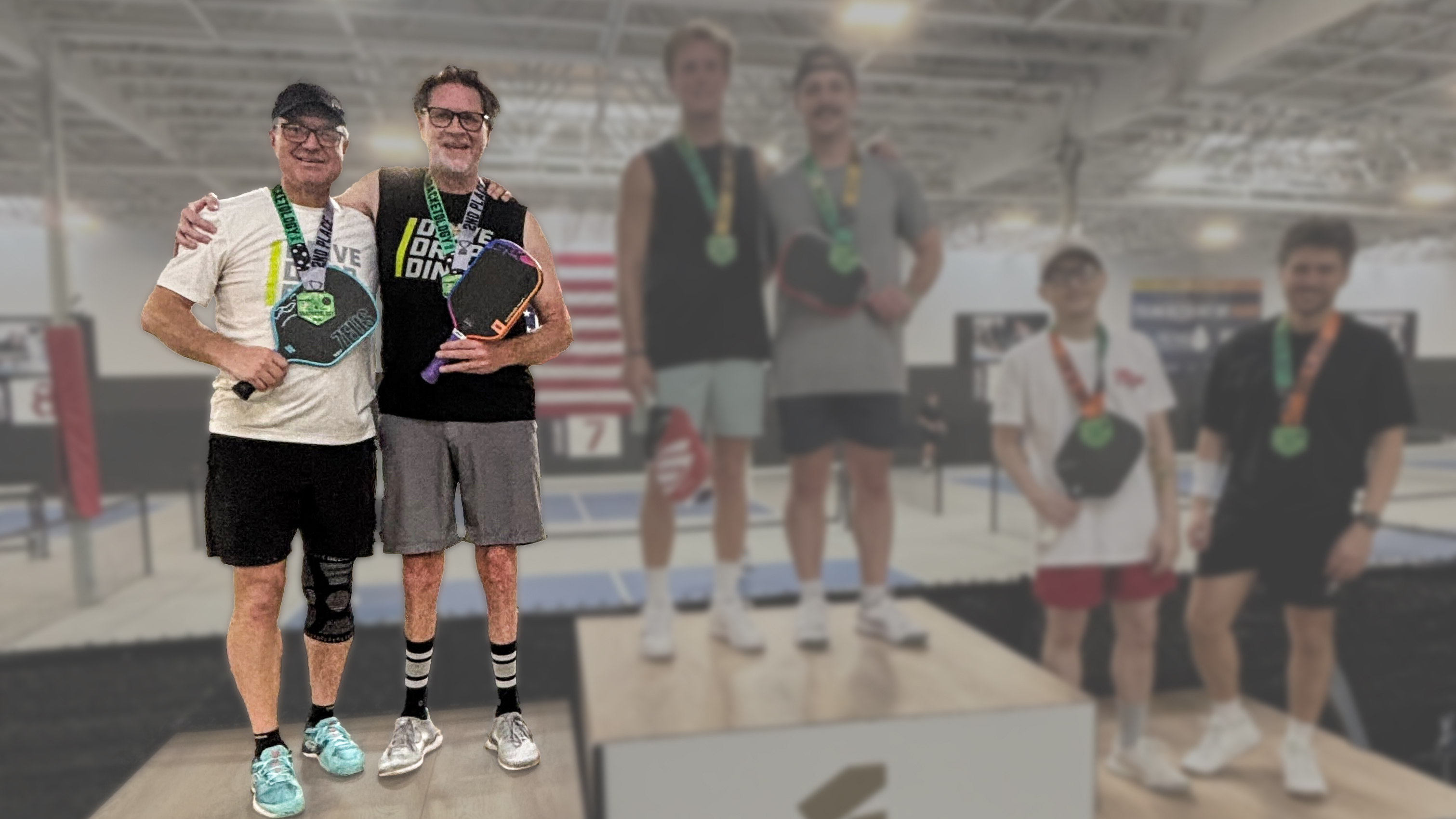
Silver Medalists, Norm and Daniel.

About the Author
Daniel Singer is a senior designer at Pickleball Central and a certified relationship coach. He is an avid pickleball player and plays with a rare disease called Charcot-Marie-Tooth. He resides in Orem, Utah.
Share Product:
SHARE THIS: